These women in the global south are fighting the harshest effects of climate change

There is always going to be chaos in our world, but how we maintain some semblance of control in our lives is by pursuing that which we feel we cannot keep quiet about.
Here is what I am pursuing: there is an enormous, rather mind-blowing gap in the information that readers in the western world receive about the countries of the global south – Asia, Africa and Latin America – that are the most vulnerable to climate change and suffering the worst consequences of climate-related disasters.
Although they are on the frontlines of climate change, these global south nations are very much underrepresented in media discussions of climate and also in climate research.
That's why I've created this newsletter, Climate Inclusive: Women's Voices From the Frontline. In it, I will be sharing the stories of incredibly driven, problem-solving, pioneering women from all around the global south to offer their insights and perspectives as they work with their communities to build climate resilience.
The Distorted View of Climate Change
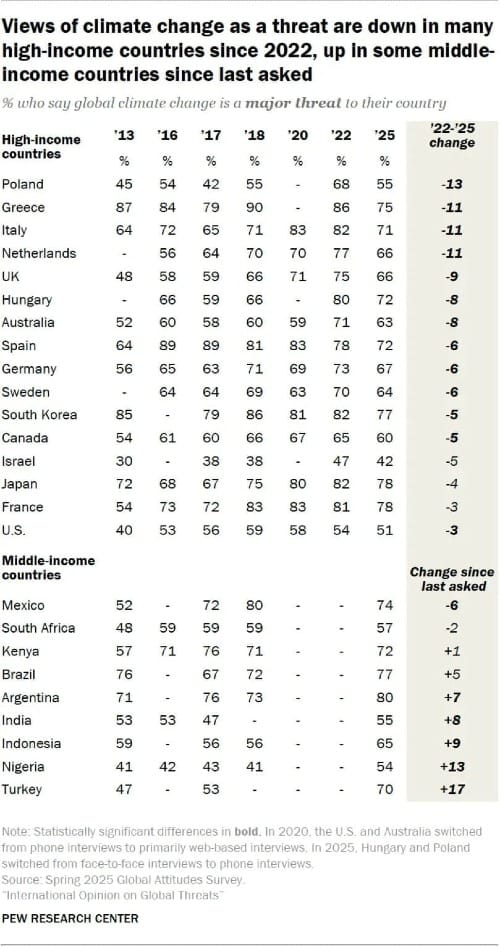
One of the problems with having such a HUGE information gap on the impacts of climate change around the world is this: a 2025 Pew Research Center survey found that people in western, wealthier nations, including the US, Canada and UK, currently view climate change as much less of an urgent issue than before:
"Since 2022, the share of people who view climate change as a major threat has decreased in many of the 16 high-income countries surveyed. This is especially the case in Greece, Italy and the Netherlands, where people are 11 points less likely today than in 2022 to see climate change as a major threat." --2025 Pew Research Center survey
Check out the percentage change according to income rank... See a pattern?
But we do not live in isolation – we live at the mercy of global climate patterns, and there is obviously a chain of consequences across the planet as temperatures rise.
Why the focus on women in this publication? Two main reasons:
1) Because women and girls are by far the most impacted by both the disastrous and also more silent effects of climate change anywhere in the world, but especially in the most vulnerable nations.
2) Because women especially in the global south are naturally taking the lead on climate solutions and awareness, always thinking about the community as a whole, despite the many harsh inequalities and barriers they continue to face. This is exactly why their voices need to be highlighted, to be brought into the center of the climate conversation, to increase their representation in the spaces where decisions are made.
I know that there are a ton of newsletters out there, but I can promise you right now that Climate Inclusive is a little different – my mission is to bring you original, eye-opening reporting and informational, inspiring stories that you will not find anywhere else.
Please subscribe (and feel free to share this widely!) to get every new story from Climate Inclusive. I thank you in advance for your support (see button below) of this free newsletter as it grows to share the power and wisdom of the bold, unstoppable women in the global south who are working tirelessly to help their people survive and thrive through the ever-evolving and worsening impact of climate disasters.