As APWLD's Climate Justice officer, Ranjana Giri is helping Asia Pacific women fight back against false climate solutions

On unraveling the myth of the carbon market, false nature-based solutions and demanding informed consent
When booking a flight, have you ever paid that extra fee to help “offset” the carbon emissions from your journey? Unfortunately, your money won't be making any actual positive climate impact. Welcome to the world of false climate solutions, a.k.a. corporate green-washing.
Essentially, the way this works is by monetizing carbon emissions: carbon offset credits are the result of slapping a price on carbon molecules – but not on the climate impact created by the companies extracting and burning fossil fuels. One carbon credit translates to one metric ton of carbon dioxide that has been removed from the atmosphere or prevented from being emitted.
Developing countries (global south nations) that don't hit their limit on producing carbon emissions as outlined by their Nationally Determined Contributions (NDC) can then sell their excess allowance – as carbon credits – on the carbon credit market. These credits are bought up by wealthier countries (global north nations mostly) and powerful corporations, which allows them to continue emitting beyond their NDC limit for carbon emissions.
But the troubling inefficacy of carbon credits has been voiced by many researchers over the years. A recent, comprehensive study that pored over the results of carbon offsetting programs from the past 25 years concluded that the entire concept was inherently flawed and resulted in low quality and unenforced projects that did not create the expected emissions reductions. Another study published in Nature analyzed one-fifth of carbon credits ever issued on the carbon market (which translated to almost 1 billion tons of CO2e) and discovered that “less than 16 percent of the carbon credits issued to the investigated projects constitute real emission reductions.”
Recognizing, challenging and rejecting carbon market schemes and other false solutions within vulnerable communities is key to Ranjana Giri's daily work as Climate Justice Officer at Asia Pacific Forum on Women, Law & Development(APWLD). A native of the Swamikartik Khapar Rural Municipality in the Bajura district in far west Nepal, Giri oversees the APWLD climate justice program that works directly with local and grassroots organizations throughout their network across Asia. Their main job: to use women-centered tools and methodologies (like Feminist Participatory Action Research, or FPAR) to help communities that are fighting to maintain their livelihoods in the face of climate change and a myriad of false climate solutions.
As Giri points out, the definition of a false climate solution is rather straightforward: “It means that the solution is not really addressing the root causes of the issue affecting the community. If the solution doesn't address that, then it cannot be a solution.”
Yet, despite the fact that carbon market does not address the root causes of carbon emissions – and has zero effect on reducing the emissions levels generated by a country or corporation – it has become an alarmingly popular climate mitigation strategy.
The carbon market impact
So what actually happens to that “carbon offset” money you give to the airline? Here's one typical scenario of a carbon reduction project: your well-meaning contribution helps the airline pay the government (via a certified carbon reduction project) of a vulnerable global south nation who is in turn paying a forest community to preserve their forest – an important carbon sink – and leave it entirely alone. However, the problem here is that the forest serves as the natural resource from which the community has been living – it is their source of income and livelihood. But because of the monstrous carbon emissions consistently being created by polluters in other parts of the world, a forest community is sometimes “forcibly evicted,” says Giri, made to to give up its livelihood and its ancient traditions.
“These kinds of carbon market solutions are introduced into our region, and that's where the grassroots communities and organizations that we work with really reject these solutions,” explains Giri.

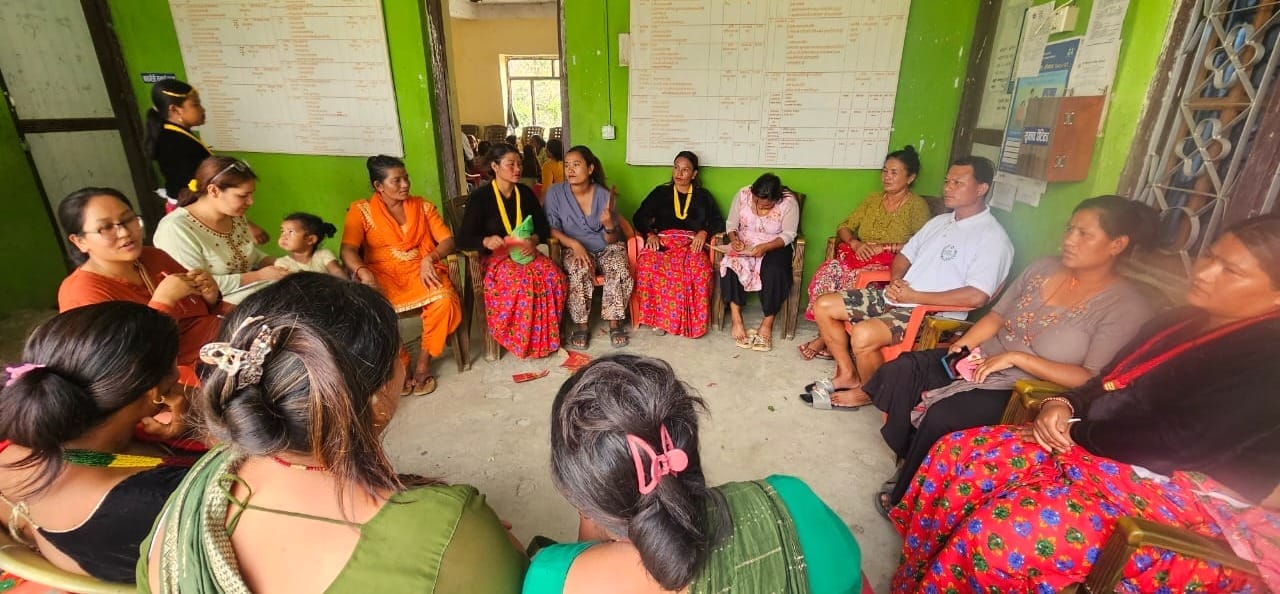
One of the women's organizations that APWLD collaborates with in Thailand had been working with communities located in a mangrove forest – a major source of carbon absorption – just as the government was planning to register the forest with a carbon markets scheme. The organization first worked with the communities to ensure that the people understood the concept of the carbon market scheme and its consequences on their forest, their natural resource. This gave the community the insights it needed “to organize themselves to reject the carbon markets,” says Giri, and they registered their mangrove forest as a community forest, keeping it out of the hands of the government so it could not be sold to the corporations who wanted it for carbon trading. Consequently, this action inspired and influenced another mangrove forest community nearby to also register their mangrove forest as a community forest.
“The other community saw what happened and said, 'Okay, we are not going to sell this community resource – we want it to be ours,'” says Giri.
Still, Giri has found that while some Asian governments that APWLD works with are more open and willing to cooperate on certain climate issues, carbon markets are usually a completely different story.
“Nepal and Bhutan are really in line with our position on climate finance demands from the global north and big polluters to pay up for all the historical and ongoing emissions. But when it comes to carbon markets, these countries are in favor of these mechanisms. As the saying goes – it is very easy to kill a man, but it is very difficult to cut down a tree, because you will get money for the carbon credits. The rules are more strict for cutting down a tree than killing a man,” Giri says.
In fact, relying on carbon reduction projects abroad in order to offset domestic emissions is the core strategy of Switzerland's 2023 agreement with Thailand. Thailand Energy Absolute’s Bangkok E-buses Program was launched as the first cooperative project in the world under Article 6 of the Paris Agreement – the agreement outlines a framework for a global carbon market. Through this program, Thailand sold the carbon credits from using the new e-buses to the Swiss company KliK Foundation. With the adoption of e-vehicles, Thailand will be reducing its emissions as indicated in their NDCs – but there is no commitment of ambitious emission reduction from Switzerland, points out Giri. So while Switzerland could technically claim they are moving toward net zero status on emissions, they are still legally permitted to emit more as they continue to buy carbon credits from Thailand.
“This clearly shows how operationalization of carbon markets is a mere pathway for net zero that fails to hold the global north accountable for their historical and ongoing emissions,” says Giri.
Nature-based false solutions
Other false solutions abound and often arrive in the form of a “nature-based” solution. The difficulty with these false conservation strategies is that they appear, on the surface, to have pure motives – like saving an endangered species or protecting the ocean. While it all sounds great, the big question to ask is who is actually benefiting from the conservation of that natural area – and at what cost?
Giri explains that sometimes, conservation entails criminalizing the communities for accessing their own resources, “capturing their lands, forest and other resources and pushing them towards forced displacement. They will frame it in a way that it is the endangered species they are protecting, but the result is that it's being sold as carbon credits. It's painted in a good light, but with the motive of profiting. It's not of benefit to the local people. Communities are made to conserve the forest while they are not able to enjoy the rights of the resource.”
In addition to this kind of land grabbing, there's also ocean grabbing, because the ocean is a huge carbon sequester – and a great opportunity for the carbon market. Many marine protected areas exist in the name of protecting endangered species, which results in restricting access to the local communities who have always done their fishing in that space and rely on fishing for their livelihood. Giri says that the creation of marine protected areas often results in the fisher folk having to find a different and much more distant route to unrestricted waters where they can continue to do their fishing.
The power of coming together
Although the challenges are endless and formidable, Giri and her colleagues continue to witness those magical moments when the women of a community start to realize just how much power they have – and what else they can achieve when working together. She recalls the story of the women of the Pattani community, located in the south of Thailand, who decided to take a stand when they understood that a coal power plant was being installed in their area. Once Giri and her APWLD team worked with the women to train them, the community women organized themselves and managed to stop the coal power plant from coming into their area.
“They were able to stop it, and from there onward, they felt that the power of women can really do a lot. So they have formed a group, and they are already working with us on climate issues, like fisher women's issues in the coastal communities, where they are affected by tidal flooding or different adaptation projects in the coastal areas,” says Giri.
Giri has also found that many communities are demanding more intensive environmental impact assessments (EIAs) to be conducted before any corporate projects begin in their area. They are seeking EIAs to be done by the government, not a consultant, to find out if the proposed projects are truly feasible in that location.
Often, no EIA is conducted before a corporation or government project starts up. And even if there is an EIA, Giri says it's done just to “tick the box.” There is no consultation or dialogue with the communities about it, although there is “cherry-picking of the community people, which ensures consent by the communities.” But the information given is one-sided, usually just presented as slides, and the full reports – only in English – are not made public.
“The community people are saying that they need to be informed, to give consent or not. They are asking whether you have followed the UN's Declaration on the Rights of the Indigenous People or not. They have never seen the corporate people coming to their communities and taking their consent, but things are happening anyway – and they have no idea who is taking advantage of them, benefiting off them. They don't want it to be there. They want it to be stopped,” says Giri.